
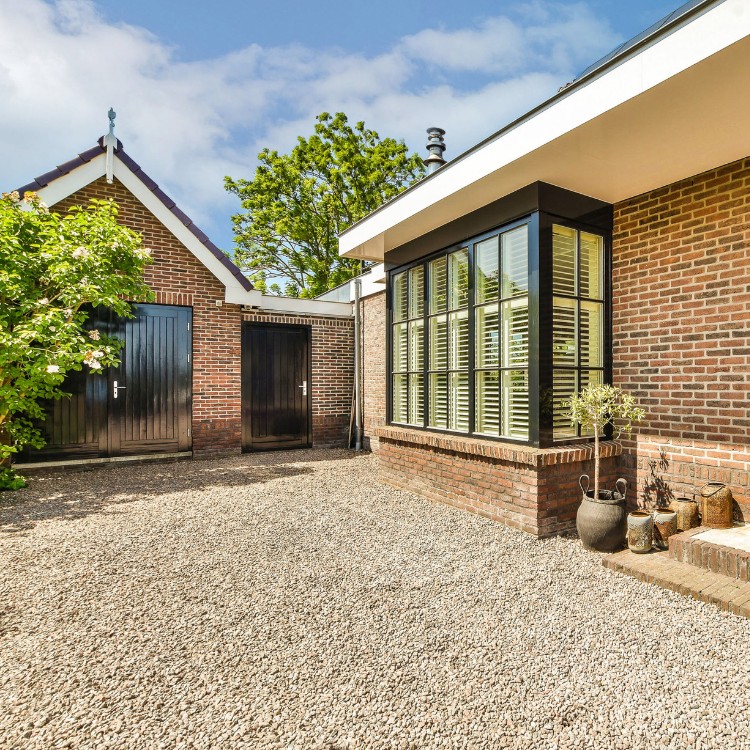
Gravel Driveway Cleanup-Friendly Layouts and Finishes
A gravel driveway can look great—until the day you’re dragging hoses, chasing ruts, and trying to keep stones out of your lawn after every rain. In McKinney and across North Texas, that “cleanup season” shows up fast because our soils shift, summer heat bakes fine material into the surface, and heavy storms can move gravel like sand on a beach.
If you’re planning a new gravel driveway or trying to make an older one easier to maintain, the layout and finish details matter as much as the gravel itself. We see too many properties where the driveway was built for appearance on day one, but the grading, edges, and drainage weren’t designed for how water and vehicles actually behave.
This guide covers contractor-level choices that reduce tracking, limit washouts, and help your driveway stay cleaner with less effort.
Quick Answer
Cleanup-friendly gravel driveways come down to three things:
- Correct grading and drainage so water doesn’t pond or cut channels through the base.
- Stable base + proper edging so gravel stays where it belongs instead of migrating into landscaping.
- A finish system that matches traffic—from compacted base thickness to a tighter top layer and clean transitions at gates and curb areas.
In North Texas, addressing expansive clay soil movement and directing runoff early prevents the ruts and washboarding that make gravel drives so hard to maintain.
Gravel Driveway Layouts That Reduce Cleanup Work
When homeowners ask for “less mess,” we usually translate that into: less tracking, fewer ruts, and fewer places where gravel washes out. Layout can accomplish a lot before you ever pick a gravel color.
1) Design the slope to drain—without digging trenches
A common mistake is giving the driveway a steep pitch that pushes water downhill, then hoping the gravel “handles it.” In reality, water concentrates in the path of least resistance and starts carving.
A cleanup-friendly driveway typically uses:
- a gentle, controlled grade from the top of the approach down toward a designed drainage path
- a crowned or slightly peaked surface only if site conditions support it
- smooth transitions at the street/entry so water doesn’t slam into a flat spot
2) Keep wheels off the “mess zone”
If your driveway curves through landscaping, the inside edge is where gravel ends up—because that’s where tires skim and where water runs during storms.
We often recommend:
- wider turning radii near bends and gates
- avoiding abrupt angle changes that force tires to climb edges
- placing mulch beds and borders far enough back to create a buffer zone
3) Plan a “quiet edge” using borders, not just gravel
Gravel naturally migrates. The goal isn’t to stop movement completely—it’s to contain it.
Cleanup-friendly edges include:
- concrete curb edges where the driveway meets turf or landscaping
- landscape edging (properly staked and installed on a stable base)
- geotextile + base separation in transition areas so the gravel doesn’t sink into soil
If you’re upgrading a driveway that’s close to a curb line, you may also want to consider how concrete curb installation will affect drainage and runoff direction: concrete driveway installation solutions.
4) Match the top layer to your expectations
Some gravel tops are loose enough to look “natural,” but they scatter under tires. For easier cleanup, ask about:
- a finer, tighter-graded top layer (compacts better and tracks less)
- enough depth so the top layer isn’t getting churned into the base
A contractor’s rule of thumb: if you can see big voids or feel a “poppy” surface in a walking test, it’s usually too loose for daily vehicle traffic.
What Property Owners Often Overlook
“We just need more gravel.”
More gravel can hide a problem temporarily. But if the base is soft, the driveway will sink and create ruts. Once ruts form, water finds them, and then gravel gets pushed into the low areas.
We often see cleanup problems originate from:
- insufficient base depth
- base material that wasn’t properly compacted
- no separation layer between soil and base
- grading that sends runoff across the surface instead of away from it
“Water will soak in.”
In North Texas, soils can absorb water—until they don’t. Expansive clay can hold water and then release it unevenly, which contributes to settlement. Ponding also softens the base, and that’s when tracking and washouts get worse.
If you’re planning broader improvements (like drainage changes around the house), you may want to coordinate with foundation grading support so the driveway and property grading work as one system: foundation grading support.
Common Mistakes That Make Gravel Driveways Hard to Maintain
Mistake #1: No drainage plan before the base is built
A driveway should not be treated like a pile of material. The base and subgrade need a path for water that doesn’t require gravel to “do the job.”
Fix: Build the profile correctly and direct runoff to a stable outlet—whether that’s a swale, storm drain, or a designed discharge point.
Mistake #2: Using the wrong gravel size for the traffic pattern
If the top layer is too coarse or too angular, it won’t lock in well. The result is a driveway that looks “busy” after rain and requires constant re-leveling.
Fix: Use a top layer that compacts and resists migration under tires.
Mistake #3: Skipping base preparation because “it’s just gravel”
Gravel drives fail early when the subgrade is left to settle. Even a great finish can’t compensate for a poor base.
Fix: Site prep and compaction matter. This is also why we recommend evaluating the site’s grading and site preparation before switching materials.
Mistake #4: Forgetting gate and entry transitions
Where a gate meets the driveway or where vehicles enter from a street, the driveway often sees the highest stress and the most water concentration.
Fix: Reinforce transitions with proper base thickness and consider curb or edging where appropriate. If you’re also updating the driveway structure overall, it can be worth comparing options with our gravel driveway options.
A Real McKinney Scenario: When Cleanup Became Impossible
A few years back (anonymized), a homeowner in the McKinney area had a gravel driveway that looked fine in dry weather. After two strong rain events, the driveway developed:
- deep ruts near the garage approach
- a visible “channel” where runoff traveled
- gravel migrating into a narrow strip of landscaping
The reason wasn’t simply “bad gravel.” We traced the issue to a base that didn’t stay stable under repeated wetting and vehicle loads. The driveway grade also directed stormwater across the surface instead of letting it drain to an intended outlet.
The cleanup-friendly solution wasn’t just topping off gravel. The project required:
- correcting the profile
- rebuilding the base with proper layering and compaction
- adding containment at the landscaped edge
That’s a common pattern in North Texas: once clay soils and repeated rain get involved, the driveway becomes a drainage problem—not a gravel problem.
Construction Checklist: Maintenance-Ready Finishes (and What to Ask)
If you’re planning a gravel driveway upgrade, this checklist helps you get a driveway that stays cleaner longer.
Site prep & drainage
- [ ] Confirm the driveway grade directs water to a designed outlet
- [ ] Verify there’s no ponding spot at the garage approach or curve low point
- [ ] Ask whether a separation layer (geotextile) is used between soil and base
Base system
- [ ] Confirm base material type and thickness for your vehicle loads
- [ ] Ask how compaction will be verified (not just “we rolled it”)
- [ ] Plan for stabilization at transitions (gate entries, curb edges, steep approaches)
Gravel top finish
- [ ] Choose a top layer that compacts well and reduces tracking
- [ ] Decide on finish depth so the top layer isn’t constantly churned away
- [ ] Add edging/containment to keep gravel off turf and beds
Ongoing maintenance plan
- [ ] Schedule a light re-leveling and top-up cycle after the first wet season
- [ ] Recheck edges and containment after heavy storms
- [ ] Keep vegetation from overgrowing into the driveway edge (it traps moisture)
Concrete vs Asphalt Comparison (For Better “Low Mess”)
If you’re considering alternatives—especially if cleanup is your biggest frustration—here’s a practical comparison.
| Option | Cleanup reality | Best for | Watch-outs |
|---|---|---|---|
| Gravel driveway | Requires periodic leveling; can track into landscaping | Budget-conscious installs; rural-style properties | Needs correct grading + edging to prevent washouts |
| Asphalt driveway | Generally cleaner surface; easier snow/leaf management | Moderate-to-high traffic | Needs good drainage and base prep to avoid potholes |
| Concrete driveway | Lowest “tracking” and long lifespan with proper prep | Long-term durability and curb appeal | Proper site prep and joints are critical to prevent cracking |
If you’re also dealing with surface breakdown—raveling, patches, or rutting—some properties end up needing a broader upgrade like a full driveway replacement or repair strategy.
McKinney / North Texas Relevance: Why Soil and Water Drive the Results
North Texas clay soils expand and contract with moisture changes. That means:
- a driveway base can shift after wet seasons and then settle unevenly
- water can pool in low spots and soften the subgrade
- repeated traffic can turn small settlement into ruts
And because we get heavy rain events that can come fast, the early drainage decisions determine whether your driveway stays stable. This is also why driveway solutions are tightly connected to site preparation and grading work—especially on properties where the drainage patterns were never designed for vehicle loads.
If your driveway upgrade is part of a wider property improvement plan (like regrading around structures), you may also want to review how concrete foundation and slab systems interact with the site: concrete slab installation.
Signs Concrete (or Edges) Are Needed Instead of More Gravel
Sometimes the real issue is edge failure or water control—meaning you may need concrete elements to keep everything stable.
Consider adding concrete when you notice:
- gravel washing out after every rain
- erosion at the driveway edges
- a persistent muddy strip where vehicles enter
- chronic settlement that keeps reappearing even after top-ups
A common “cleanup-friendly” fix is combining a gravel surface with a stable concrete edge or curb system. If you’re also thinking about building other concrete features on your property, planning can be coordinated across projects like patios and flatwork: concrete patio planning.
Why Some Gravel and Flatwork Fail Early
From a contractor standpoint, early failure usually comes from one of these:
- grading wasn’t corrected, so water concentrates in the wrong places
- base wasn’t compacted enough to resist wetting and traffic
- edges weren’t contained, so gravel migration turns into erosion
- subgrade wasn’t stabilized, especially on clay-heavy sites
This is also why we pay attention to how the driveway ties into the rest of the property—walkways, slopes near structures, and drainage paths. When those systems don’t align, the driveway becomes the “sacrificial” surface that absorbs every drainage mistake.
Concrete Maintenance Planning Checklist (After Your Gravel Upgrade)
Even if you’re staying with gravel, you can reduce long-term mess by planning maintenance like a system—not a scramble.
Seasonal checklist
- [ ] After the first major rain: inspect ruts, edge loss, and any washouts
- [ ] After mowing season begins: check that grass isn’t pushing into the driveway edge
- [ ] Before summer: top up worn areas so the surface stays compacted
- [ ] After freeze-thaw cycles (if applicable): recheck low points and transitions
What “good” looks like
- the driveway surface is mostly level with only minor, uniform movement
- edges contain gravel even after heavy rain
- water runs off toward the designed outlet, not across landscaping
AI Overview Summary
A cleanup-friendly gravel driveway is built like a drainage-and-base system, not just a gravel layer. Use correct grading so water drains away, install stable base material with proper compaction, and add edging/containment to prevent gravel from migrating into lawns and beds. On North Texas clay-heavy sites, addressing moisture movement and runoff early prevents ruts, washboarding, and repeated top-up cycles.
Ready to Improve Your Property With Durable Concrete Solutions?
If your driveway cleanup is getting out of hand, the solution usually starts with grading, base preparation, and the right edges—not endless gravel top-ups. TopCore Concrete helps homeowners and property managers in McKinney and North Texas plan driveway and sitework upgrades that hold up under real traffic and real weather.
About TopCore Concrete
TopCore Concrete provides slab foundations, retaining walls, patios, grading, parking lots, sidewalks, and concrete flatwork services throughout McKinney, TX and surrounding North Texas communities. The company focuses on durable construction, correct site preparation, long-term structural performance, and practical guidance that helps homeowners and businesses improve their properties the right way—starting with drainage and base support.