
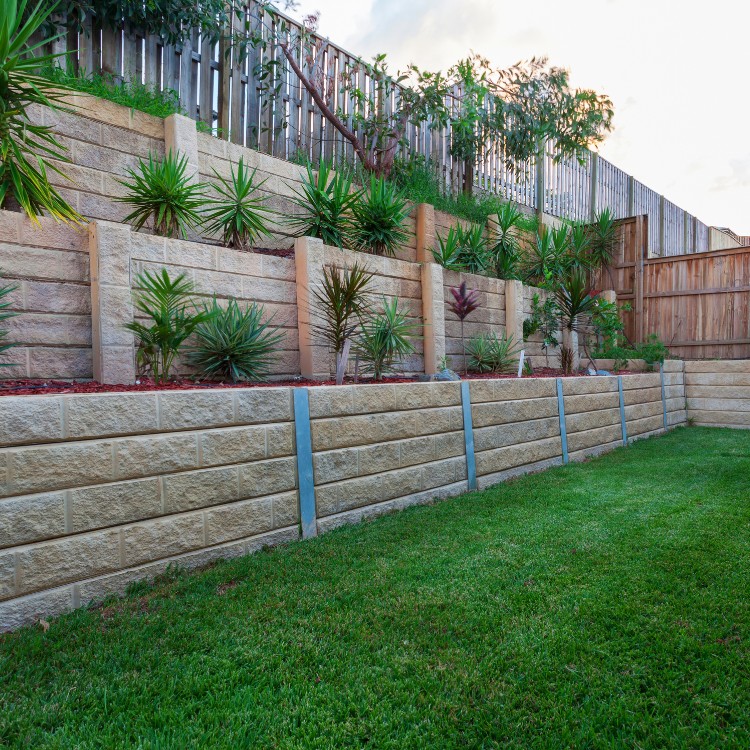
Retaining Walls Built for Retaining More Than Soil
If you’ve ever watched heavy rain turn a backyard slope into a muddy, fast-moving channel, you already know why retaining walls matter. In McKinney and across North Texas, water doesn’t just “sit there”—it finds the path of least resistance, saturates soil, and pushes pressure where it shouldn’t go. When a retaining wall is built without the right base, drainage, and reinforcement strategy, the damage often looks “mysterious” at first: bulging blocks, gaps at the corners, leaning caps, and soft spots that show up after the next storm.
At TopCore Concrete, we treat retaining walls as a complete earth-support system—because they’re not only holding back soil. They’re managing soil pressure, controlling groundwater, protecting adjacent concrete, and preserving the grade around patios, sidewalks, driveways, and even slab foundations.
Quick Answer
A strong retaining wall in North Texas needs more than blocks or concrete. It needs:
- Proper excavation and compacted base
- Correct wall design for lateral earth pressure
- Drainage behind the wall (so water pressure doesn’t build up)
- A stable drainage outlet (so water actually leaves the system)
- Compatibility with nearby concrete flatwork (patios, sidewalks, and driveways)
When those pieces are handled correctly, the wall holds up through wet seasons and shifting expansive clay. When they’re skipped, failures usually start underground and appear above grade later.
The Retaining Wall System We Build (Not Just the Wall)
Retaining walls fail most often because the “cause” is hidden. On the surface, you may see a slight bow or a small separation. Underground, the story is usually different: water got behind the wall, soil expanded, and lateral pressure increased far beyond what the wall could safely handle.
What we focus on in the field
When we plan and build retaining wall projects, we start with the work that keeps everything stable:
1. Site preparation and subgrade stability
- We remove unsuitable material and verify compaction targets for the base and backfill zones.
- In North Texas, expansive clay can change volume with moisture swings, so subgrade stability matters as much as wall height.
2. Base support and reinforcement strategy
- Depending on wall type and height, we may use reinforced concrete elements, engineered design, or a structured base that prevents settlement.
- For concrete foundations and flatwork adjacent to the wall, we also consider how settlement could translate into cracking or uneven slabs.
3. Drainage that actually works
- We don’t treat drainage as an afterthought.
- A common approach includes a drainage layer behind the wall, proper filter fabric where needed, and drainage outlets that direct water away from the wall and nearby concrete.
4. Backfill selection and placement
- Backfill isn’t “whatever fits.” The gradation and moisture condition affect compaction and water movement.
- We place and compact in lifts to reduce voids—because voids become pathways for water and soil migration.
A real-world scenario we see in North Texas
A homeowner in a fast-growing part of McKinney wanted a level backyard for a patio. The slope had been “fine” until two heavy rain events in one month. After the storms, they noticed water pooling along the lower edge of the yard and a slight depression behind the existing wall line. We found that water was saturating the soil behind the wall and causing a soft zone that settled unevenly. The fix wasn’t simply replacing the caps—it involved reworking drainage behind the wall and stabilizing the backfill so the new concrete patio area wouldn’t settle.
What Property Owners Often Overlook
Many homeowners focus on the “look” of the wall—block color, capstone style, or the straightness of the visible face. That’s understandable. But the biggest problems are structural and drainage-related.
Here’s what we commonly see overlooked:
- No drainage plan behind the wall
Water pressure builds up behind the wall and pushes laterally—even if the wall face looks solid.
- Backfill placed without proper compaction
Loose backfill settles later, creating voids and allowing soil migration.
- Drainage outlets that discharge in the wrong place
If the outlet sends water toward a slab, walkway, or foundation grading area, you’ve effectively moved the problem to a new location.
- Ignoring how grading affects adjacent concrete
If the wall changes the way water runs, your driveway, sidewalks, and patios may experience differential settlement and cracking.
If your retaining wall is near concrete flatwork, it’s also worth coordinating with grading and site preparation so water flow patterns don’t undermine what you’re about to pour.
For related sitework planning, you may also find our foundation grading support helpful, especially when a wall ties into areas near a slab or foundation.
Mistakes That Cause Drainage Problems
Retaining walls often fail early due to predictable installation errors. We address these because they’re hard to fix after the wall is already in place.
Common mistake property owners make
They assume the wall will “solve the water problem.”
But a wall without drainage is like putting a dam in place and sealing the back side. Water still needs somewhere to go, and in Texas soil, that pressure can increase quickly.
Other installation mistakes we see
- Skipping filter fabric where fine soils migrate into drainage stone
- Using the wrong stone size behind the wall
- Not pitching or routing underdrain discharge to a stable outlet
- Backfilling too quickly without compacting in lifts
- Failing to account for seasonal moisture changes in expansive clay
In North Texas, expansive clay expansion and contraction can be dramatic. Combine that with summer heat, wet-season saturation, and fast runoff during storms, and you get the exact conditions where “good enough” drainage becomes a long-term liability.
Construction, Repair, and Maintenance Checklist
A well-built retaining wall is meant to last, but maintenance reduces risk and catches small issues before they become structural problems.
Maintenance / planning checklist (simple but effective)
- Inspect after major rain events for:
- bulging or leaning along the face
- new gaps at joints or corners
- erosion channels forming at the base
- Check drainage pathways
- confirm discharge is clear and not blocked by mulch, soil, or landscaping
- Watch for water-related damage nearby
- cracking or settling near patios, sidewalks, or driveways
- Clear vegetation and debris
- roots and trapped debris can block outlets and reduce drainage performance
- Re-grade surface runoff away from the wall
- water should sheet away, not collect behind or at the base
If you’re planning new concrete around the wall, we strongly recommend coordinating drainage before concrete patio installation. Patio settlement often begins with the same root cause: water and soil movement.
When repairs are needed
Signs you may need retaining wall repair (or a drainage retrofit) include:
- recurring water pooling behind the wall
- worsening bulges after rain
- soil washing out at the base
- repeated surface cracking in adjacent concrete
In some cases, repairs are a localized fix. In others, the most durable solution is improving drainage and reworking backfill and base support so the wall can stabilize.
Concrete vs Asphalt Comparison (When a Wall Protects a Driveway)
A retaining wall is frequently built to protect a driveway, parking area, or entry approach—especially where grade changes. When you’re improving those areas, you may be choosing between concrete and asphalt options.
Here’s a practical way to think about it:
| Feature | Concrete Driveways / Flatwork | Asphalt Driveways / Parking Lots |
|---|---|---|
| Suitability near grade changes | Often strong when base prep and drainage are correct | Can perform well, but base and drainage are critical to prevent rutting |
| Crack behavior | Cracks can occur but are often manageable with proper jointing and base prep | Can soften in heat and rut if base prep is weak |
| Maintenance | Sealing and repairs can extend service life | Resurfacing and sealing cycles are typically needed over time |
| Best outcome | Depends heavily on grading, foundation support, and drainage routing | Depends heavily on base strength and water control |
If you’re planning a driveway near a wall or slope, your base prep and water routing matter as much as the surface material. For concrete-specific work, you may want to review driveways installation solutions so the project is designed as a system, not a single pour.
McKinney and North Texas Relevance: Why Soil and Water Are the Real Projects
In McKinney, the biggest “hidden variable” is often the soil itself—expansive clay that can expand when wet and pull back when dry. That movement can stress walls, but it also stresses what’s built near them: concrete slabs, sidewalk runs, and driveway edges.
We also see rapid suburban growth that increases grading activity. New development, landscape changes, and added impervious surfaces can shift where water runs. Even if the original retaining wall was built decently, later site changes can overwhelm the drainage capacity.
One firsthand observation that keeps showing up in our work: when water is allowed to pool uphill from a wall, the wall doesn’t fail immediately—it fails after repeated cycles. That’s why we treat drainage outlets, flow direction, and base preparation as part of the long-term design, not just “sitework tasks.”
If your project also involves foundation-related grade work, pairing retaining wall planning with slab foundations considerations can help you avoid future cracking and uneven settlement in areas where concrete structures meet grade changes.
A Case Example: Stabilizing a Slope for a New Patio and Walkway
An anonymized project we worked on involved a backyard slope where a retaining wall separated a yard area from a lower walkway route. The homeowner wanted a new patio and concrete walkway, but the existing slope drainage was poor. During storm season, water ran directly along the wall base and seeped toward the lower walkway area.
Our solution sequence looked like this:
- Rework the drainage behind the wall with a proper filter and outlet strategy
- Improve backfill placement with compaction in lifts
- Stabilize the area supporting the walkway so it wouldn’t settle after the patio was installed
- Coordinate patio and walkway elevations with the updated drainage plan
The result wasn’t just a “nicer look.” It was a system that reduced water pressure cycles that would have threatened both the wall and the new concrete flatwork.
If you’re dealing with similar conditions and you’re also planning other improvements, it may help to align the entire site plan—patios, sidewalks, and drive approaches—rather than handling each component in isolation.
Ready to Improve Your Property With Durable Concrete Solutions?
Retaining walls built for real performance protect more than aesthetics. They protect your grade, your drainage patterns, and the concrete you rely on—driveways, sidewalks, patios, and slab areas. The most durable projects start with the right base, correct drainage routing, and backfill compaction that matches North Texas soil behavior.
If you’re planning a new retaining wall or addressing a wall that’s already shifting after rain, we can help you map out a practical, long-term solution.
About TopCore Concrete
TopCore Concrete provides slab foundations, retaining walls, patios, grading, parking lots, sidewalks, and concrete flatwork services throughout McKinney, TX and surrounding North Texas communities. We focus on durable construction through proper site preparation, drainage planning, and long-term structural performance—helping homeowners and businesses build concrete systems that hold up through Texas weather and soil conditions.