
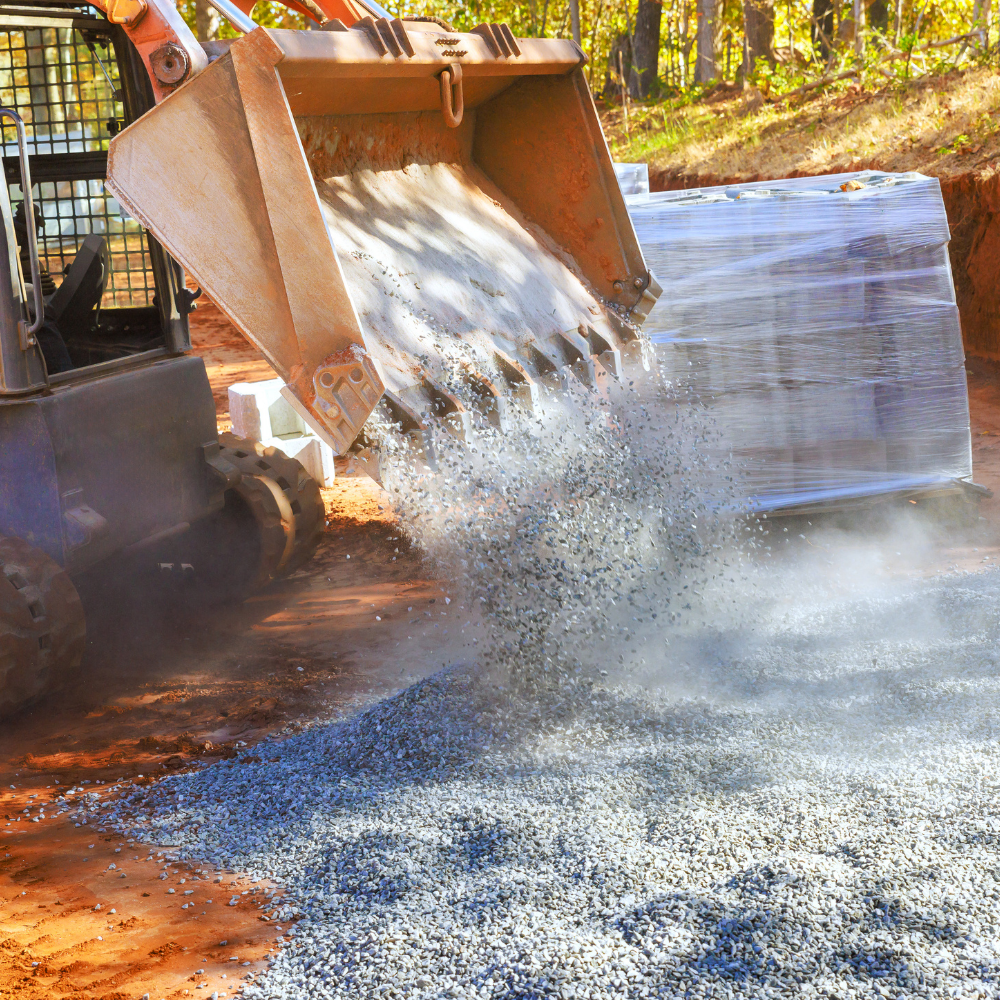
Gravel Driveway Installation for Quiet Wheels and Clean Lines
A gravel driveway can be one of the best “first upgrades” a property owner makes—until it isn’t. In McKinney and the surrounding North Texas area, we see a predictable pattern: a driveway looks fine for a season, then after a few heavy rain events the surface starts to rut, washboards appear, and the edge starts to creep into the lawn. The result is a driveway that’s louder under tires, harder to maintain, and—if drainage is ignored—eventually risky for nearby structures.
The good news? A well-built gravel driveway isn’t guesswork. With the right base thickness, proper grading, and clean edge control, you can get quiet, stable rolling support for vehicles and a neat visual line that stays put.
Quick Answer
For a quiet, clean-looking gravel driveway, the foundation matters more than the gravel. A durable install usually includes:
- solid site preparation and subgrade stabilization (especially on expansive clay)
- correct base layers and compaction
- engineered grading for drainage (water should move away, not soak in)
- an edge strategy to stop the material from migrating
- a maintenance plan that keeps fines from turning gravel into mud
What Gravel Driveway “Quality” Really Means (Quiet Wheels + Clean Lines)
Most homeowners think about gravel size and color first. Those choices matter, but they’re not what makes the driveway quiet and stable over time. In practice, driveway performance comes from three systems working together:
1) Base structure that supports load
Vehicles don’t just “sit” on gravel—they move, push, and shear the surface. If the subgrade is soft or inconsistent, the base layer gets displaced. That displacement is what creates:
- ruts (washboarding over time)
- uneven transitions at the driveway edge
- pumping of fines during wet weather
2) Drainage grading that prevents saturation
In North Texas, heavy downpours can turn clay subgrade into a weak layer quickly. If water is allowed to infiltrate and remain, you’ll see early failures like rutting and gravel breakdown.
A properly graded gravel driveway should shed water and avoid low spots. Even a small change in elevation can keep the driveway from acting like a sponge.
3) Edge control for a crisp visual boundary
“Clean lines” come from restraint. Without an edge system, gravel tends to migrate—especially where tires turn or where mowing equipment bumps the edge. Over time, it becomes a broad, messy strip instead of a defined driveway.
If you’re also planning other site improvements—like driveway installation solutions for a future replacement or expansion—edge planning now can save a lot of rework later.
A Real-World Scenario We Commonly See in North Texas
Here’s a typical situation from our experience: a homeowner in a growing North Texas neighborhood installs a “good enough” gravel driveway over an uneven area. The driveway is level at first, but the subgrade has soft spots. After the first major rain, water collects in low areas. A few weeks later, tires carve tracks through the fines and the gravel starts to migrate downhill.
The homeowner usually responds by adding more gravel—sometimes multiple times. But that often makes the surface look thicker while hiding the real issue: the base is still unstable and saturation is still happening. The driveway gets noisier because the surface is less uniform, and the edges lose definition because the material is moving sideways.
The fix is not “more gravel.” It’s base + grading + stabilization.
What Property Owners Often Overlook
A gravel driveway can look simple, but it’s still sitework. The most overlooked items are underground decisions:
- Subgrade stabilization: Expansive clay can expand and contract, and it can lose strength when saturated.
- Compaction and layer thickness: If the base isn’t compacted in lifts, the driveway can settle unevenly.
- Drainage direction: Water must have a route to go somewhere. If you don’t plan it, nature will—often through the driveway.
- Edge restraint: Without a controlled boundary, gravel migrates into landscaping and creates a rough perimeter.
Why Some Gravel Driveways Fail Early (Contractor Observation)
One firsthand thing we watch for on job sites: where the surface starts breaking down first. On many failing drives, the earliest deformation appears:
- near the entrance where vehicles turn,
- along the edges where water spreads outward,
- and in transitions where the driveway crosses a slope.
That pattern tells us the root cause is typically base movement and drainage spread—not the gravel itself. When fines migrate and the base loses support, the surface becomes inconsistent. That’s when you start hearing the “rattle” and feeling the bounce under tires.
Common Mistakes That Cause Drainage Problems
1) Installing over topsoil or loose fill
Topsoil is organic and unstable. Even if it looks firm at first, it can break down under moisture and traffic.
2) Skipping grading details
A driveway that’s “mostly level” can still have micro-low spots. Those spots become water traps during storms.
3) Using the wrong gravel for the job
Some gravel blends look good but don’t lock together as intended. If the gradation is off, you’ll get more movement and quicker breakdown into fines.
4) Not planning for edge migration
Once gravel starts migrating, it often drags fines with it. That’s how you end up with muddy zones and a driveway that requires constant reshaping.
5) Forgetting the rest of the property drainage system
If roof runoff, yard grading, or nearby drainage isn’t aligned with the driveway’s drainage plan, the driveway becomes the path of least resistance.
If your driveway is also near foundation areas or you’re doing larger site improvements, it’s worth thinking in systems. For example, foundation grading support can help protect nearby concrete foundations by keeping water movement controlled.
Construction, Repair, or Maintenance: A Gravel Driveway Planning Checklist
If you’re planning a new gravel driveway—or improving an existing one—use this checklist to guide expectations. A professional install should cover these items clearly before material goes down:
Site prep + base
- Confirm subgrade condition (and remove unsuitable material if needed)
- Establish driveway slope and cross-slope for drainage
- Build base in compacted lifts (not one thick dump)
- Use appropriate base material for load-bearing and drainage
Surface + edging
- Choose gravel type/gradation suited to vehicle traffic and local conditions
- Maintain a consistent thickness across the driveway
- Install edge restraint to keep lines crisp
Drainage detailing
- Plan where water goes after storms
- Avoid low spots and ponding areas
- Coordinate with any existing swales, gutters, or yard grading
Maintenance schedule
- Inspect after major rain events for ruts or washed-out edges
- Add gravel sparingly and only where needed
- Re-grade surface lightly as it begins to lose shape
- Keep vegetation from encroaching into the gravel edge
Concrete and Gravel: When You Should Consider More Than Gravel
Gravel is great for cost-effective access and drainage flexibility, but some properties eventually want a hard surface for convenience and longevity. If you’re planning to upgrade to concrete later, you’ll still want a strong base now—because future driveway replacement depends on stable subgrade.
If your end goal is a longer-term surface, you may prefer gravel driveway installation that’s built as a system from day one, or a transition plan toward concrete driveway installation when the time is right.
An Example Case: “Quiet Again” Driveway Reshape and Base Upgrade
We worked with an anonymized homeowner who had a gravel drive that sounded louder every month. After rain, it developed washboard lines and the entrance area turned into a muddy track.
We evaluated the driveway and found:
- the subgrade had inconsistent support,
- the driveway had gentle low spots that trapped water,
- and the edge restraint was minimal, so the gravel migrated outward.
Instead of just adding stone, the project approach focused on base correction and drainage grading. After re-establishing slope, compacting base in lifts, and resetting the edge control, the surface stabilized. The homeowner reported less tire noise during the first dry week—because the surface stopped moving under load and returned to a more uniform profile.
McKinney and North Texas Relevance: Why Soil and Weather Decide Everything
North Texas soil—especially expansive clay—can be unforgiving. It expands with moisture and can lose strength when saturated. Then summer heat drives contraction and movement again. That cycle is why driveways fail “out of nowhere” after a season of normal weather.
Also, the region can see intense rainfall that arrives faster than yards can absorb. When water doesn’t have a controlled path, it doesn’t just wet the surface—it can weaken the base. A gravel driveway built for drainage and compaction performs better through these cycles, while an install that ignores grading often requires constant patching.
Key Takeaway
A quiet, clean gravel driveway is mostly about site preparation, base compaction, and drainage grading. Gravel selection matters, but it can’t compensate for weak subgrade or poor water control.
Quick Comparison: Gravel vs Concrete (When Planning for the Future)
| Feature | Gravel Driveway | Concrete Driveway |
|---|---|---|
| Quiet ride | Can be very quiet with stable base | Very smooth, typically quiet |
| Drainage | Often flexible, but needs correct grading | Needs design to handle water movement |
| Maintenance | Periodic re-leveling and stone top-off | Repairs/sealing as needed |
| Longevity | Depends on base + drainage | Long service life with proper prep |
| Best fit | Budget-conscious access, certain site layouts | High-traffic convenience, long-term finish |
If you’re weighing options, it helps to think about how your driveway affects the rest of the property. For example, if you’re also working on parking lots for a small business, the same lessons apply: base prep and drainage determine whether the surface holds up under repeated turning and braking.
Signs Concrete Needs Repair (and Might Be Related to Drainage)
If you already have concrete nearby—like a driveway apron, walkway, or patio—watch for these warning signs. They often point back to grading or water management:
- hairline cracks widening after rain
- uneven slabs or small “steps” at joints
- recurring wet areas near the driveway edge
- spalling or surface scaling
- water staining that returns after storms
If you’re seeing these symptoms and planning any major improvements, it’s smart to coordinate your sitework so drainage doesn’t undermine new or existing flatwork. For example, a property with settlement issues may also need slab foundations support as part of a broader stabilization plan.
FAQ
How do I keep a gravel driveway from getting noisy?
Noise usually comes from an unstable or uneven surface. After heavy rain, check for ruts, washboarding, and areas where tires “sink” slightly. Those are signs the base is moving or fines are breaking down. The fix is usually base correction and re-grading—not just adding more gravel.
Why does my gravel driveway wash out at the edges?
Edge migration is commonly caused by weak restraint and water spreading outward. If water can’t shed properly and the boundary isn’t controlled, gravel will move and carry fines with it. A clean curb or edge strategy keeps the material where it belongs.
Can I install a gravel driveway over existing concrete?
Sometimes, but it depends on what’s underneath. If the existing surface is broken, uneven, or not draining correctly, you’ll likely inherit the problem. In many cases, sitework that corrects drainage and base condition is the safer path before building a new gravel surface.
Is gravel okay for driveways in North Texas?
Yes, but it must be built like a driveway—not a decorative strip. With expansive clay soils and intense storms, grading, base preparation, and compaction are what determine performance.
Ready to Improve Your Property With Durable Concrete Solutions?
If you want a gravel driveway that stays defined, sheds water correctly, and doesn’t turn into a noisy, rutted track, plan the base and drainage first. TopCore Concrete brings practical North Texas sitework experience to help you build a driveway system that performs—now and through the next rainy season.
About TopCore Concrete
TopCore Concrete provides slab foundations, retaining walls, patios, grading, parking lots, sidewalks, and concrete flatwork services throughout McKinney, TX and surrounding North Texas communities. The company focuses on durable construction, proper site preparation, long-term structural performance, and helping homeowners and businesses improve their properties through professional concrete and grading solutions.