
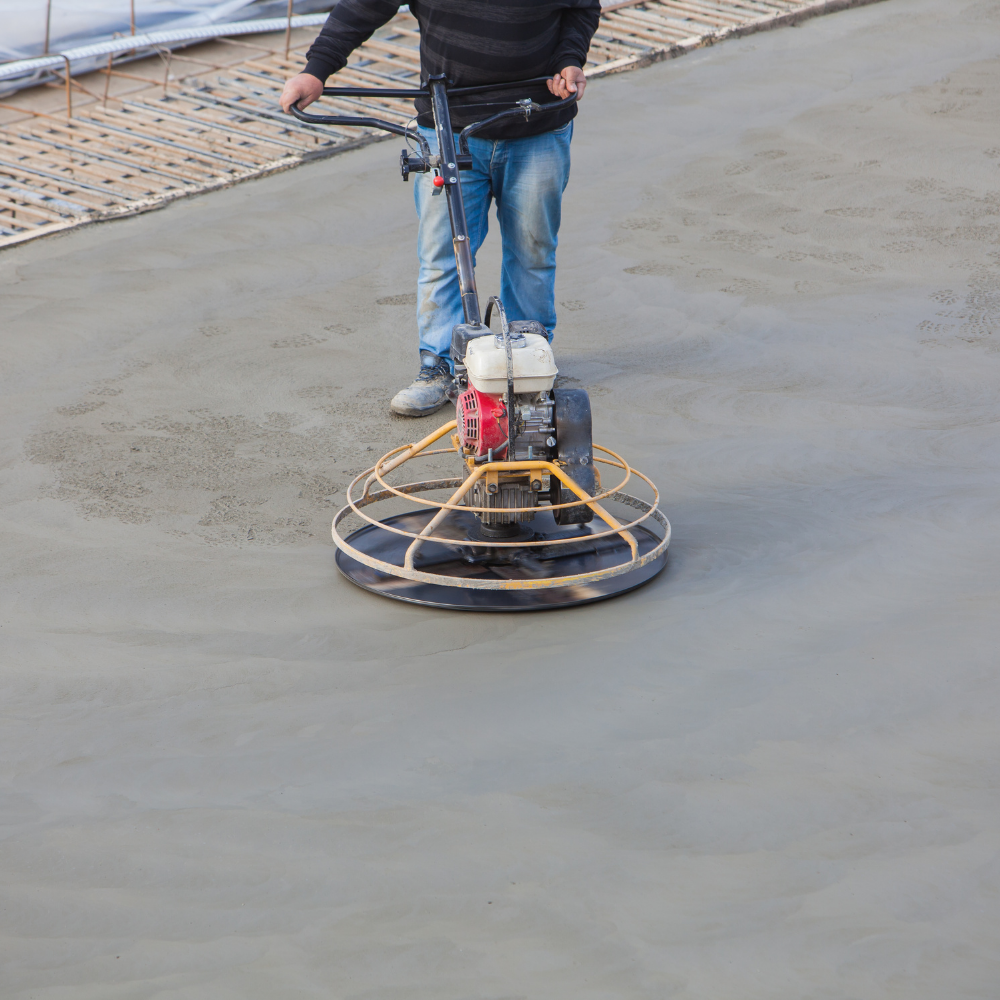
Slab Foundations With Strong Edges and Smooth Finish
A lot of concrete problems don’t start with the concrete—they start with what’s underneath it. In McKinney and across North Texas, we commonly see slab foundations and exterior flatwork develop early issues after heavy rain or seasonal soil movement. Homeowners will notice hairline cracking near edges, doors that feel slightly harder to close, or small uneven spots that weren’t there the year before.
That’s why “strong edges and a smooth finish” matters. A smooth top surface looks good, but the real durability comes from how the slab is supported, how the edges are formed and reinforced, and how water is managed before and after the pour.
Quick Answer
Strong slab foundations aren’t just poured and finished—they’re engineered with proper subgrade preparation, correct base thickness, reinforced edges, and a grading/drainage plan that keeps water moving away from the foundation. In North Texas, expansive clay soil and intense rain events make grading and moisture control especially important. If you want a slab that stays level and performs for decades, the project needs the full system: site prep, foundation design, concrete placement, and post-pour drainage.
Why Strong Edges Matter More Than a “Perfect” Surface
When homeowners ask about slab foundations, they usually point to the visible side—straightness, finish quality, and whether the surface looks smooth. Those things matter, but as a contractor I’ve learned to watch the foundation in three phases:
1. Before the pour: how the subgrade is compacted and stabilized, and whether the site has a drainage path that doesn’t dump water toward the slab.
2. During the pour: how concrete is placed, how reinforcement is tied, and whether the edges are properly formed and consolidated.
3. After the pour: how curing is handled and whether the grading around the slab directs water away consistently.
A slab can look fine on day one and still fail early if the edges are weak or if water is allowed to sit against the perimeter. In Texas clay, the edge area is where moisture changes often show up first—especially when gutters, downspouts, or lot grading push runoff toward the foundation.
What Property Owners Often Overlook
1) Water management is part of the foundation system
Many people focus on concrete thickness but ignore where the water goes. In North Texas, heavy rain can turn a small grading error into a long-term moisture problem. Even if the slab is reinforced, water that repeatedly saturates the soil near the edges can lead to movement.
2) “Level” isn’t the same as “stable”
You can sometimes get a slab to look level during construction, but if the subgrade isn’t properly compacted or stabilized, it may settle later. That’s why proper base prep and compaction testing matter.
3) Smooth finish can’t compensate for poor preparation
Finishing helps with appearance and some surface durability, but finish alone doesn’t fix voids, inconsistent support, or drainage issues.
4) Edge reinforcement and forming details are where longevity is won
The perimeter is exposed to more variables—water, temperature swings, and soil expansion/contraction. Strong edges typically mean:
- properly formed perimeter support
- reinforcement placed as designed
- consistent concrete consolidation around the edge zone
Our Experience Building Concrete Systems in Texas Conditions
Here’s a firsthand pattern we see often: during site prep, the excavation looks “clean,” but once we remove loose material and rework the subgrade, the density isn’t uniform across the footprint. In one anonymized project, a slab for a residential addition was staged for a fast schedule. The crew completed excavation and started base placement, but after re-checking compaction patterns, we found areas where moisture conditions weren’t consistent. The fix wasn’t dramatic—additional base adjustments and re-compaction—but it prevented a future problem where the slab’s edge would have been more likely to settle relative to the center.
That’s the contractor observation that matters: foundation issues frequently begin as support inconsistencies, not surface defects.
Concrete vs. Asphalt Comparison (For Driveway Approaches to Foundation Edges)
If your foundation plan includes a driveway or exterior approach, it helps to think about how the surface interacts with grading and drainage. Driveways act like “water highways” during storms.
| Feature | Concrete Foundations / Slabs (System-Based) | Asphalt Driveways (Surface-Based) |
|---|---|---|
| Primary strength driver | Subgrade prep + reinforcement + edge support | Base prep + asphalt thickness + drainage |
| Common early symptom when drainage fails | Edge cracking, slight settling, moisture-related movement | Soft spots, rutting, water pooling |
| Best improvement | Correct grading and water routing | Proper base + surface grading + sealing maintenance |
| Long-term performance | Strong when built as a system | Durable when base prep and drainage are right |
For driveway planning and base prep, we often coordinate with projects that also need concrete driveway installation solutions so the drainage pattern doesn’t undermine the foundation perimeter.
Common Mistakes That Cause Drainage Problems
Mistake 1: Relying on “natural slope” instead of designing runoff paths
A site can look like it drains when it’s dry—but behave differently during a 2–4 inch North Texas rain event. The foundation perimeter needs predictable drainage, not luck.
Mistake 2: Gutters and downspouts discharging near the foundation
If downspouts dump close to the slab edge, water infiltration becomes a cycle. Over time, that moisture can soften supporting soils and contribute to movement.
Mistake 3: Skipping site preparation and stabilization
Concrete can’t “fix” weak subgrade. If the base is too thin, poorly compacted, or not uniform, cracks and settlement become more likely—especially near slab edges.
Mistake 4: Pouring without confirming edge conditions
Perimeter support details—forms, reinforcement placement, and consolidation—need attention. A weak edge is where many slab issues start because it’s also where moisture and temperature changes concentrate.
Mistake 5: Treating foundation grading as cosmetic
Foundation grading impacts how water behaves for years. If the grade is wrong, sealing the surface won’t solve the real issue.
Construction, Repair, and Maintenance: A Checklist for Long-Term Performance
Below is a practical checklist you can use whether you’re planning a new slab foundation or addressing existing issues in concrete flatwork.
Pre-Pour Planning Checklist (Best done before concrete work begins)
- Confirm the drainage direction around the slab (water should move away, not toward).
- Verify subgrade is properly excavated and compacted.
- Ensure base materials meet the project requirements and are installed uniformly.
- Confirm reinforcement placement and edge detailing match the design.
- Plan for curing protection based on temperature and wind conditions.
Post-Pour Maintenance Checklist (What keeps slabs performing)
- Keep gutters/downspouts routed away from the foundation perimeter.
- Maintain consistent grading around the slab—avoid low spots where water can collect.
- Watch for early warning signs:
- new cracks near edges or corners
- separation at joints
- doors/windows that begin to stick slightly
- Address small drainage problems early—water is the enemy of stable support.
- Maintain any sealing or protective treatments recommended for your specific concrete exposure.
If you’re seeing settlement or unevenness
A practical approach is to evaluate whether the issue is drainage-related, base support-related, or tied to foundation repair needs. In many cases, the best results come from combining correction of moisture/grade with a foundation-focused stabilization plan. If you suspect movement, it’s worth exploring foundation repair options or a stabilization strategy that matches what’s happening on-site.
Signs Concrete Needs Repair (Including Foundations and Exterior Flatwork)
Not every crack means structural failure, but some patterns are red flags. Consider repair or further evaluation if you notice:
- Cracks widening after rain (suggests moisture-related movement)
- Cracks concentrated at slab edges (often linked to perimeter support and drainage)
- Uneven slab sections or trip hazards (support inconsistency or settlement)
- Spalling or surface scaling (often tied to moisture intrusion or freeze/thaw cycling—less common in Texas, but still possible with trapped water)
- Persistent dampness near the foundation (grading/drainage or downspout discharge issues)
If your project includes exterior concrete that needs attention, we also see homeowners needing concrete repair after drainage issues caused localized damage. Repair is most effective when the underlying water problem is corrected first.
McKinney / North Texas Relevance: Why the Climate and Soil Change the Rules
North Texas soil is famous for being tricky—especially expansive clay. Clay expands when it’s wetter and shrinks as it dries. Add seasonal swings, construction activity, and heavy rain, and you get conditions where foundation performance depends heavily on:
- consistent moisture control around the slab
- engineered drainage paths
- stable base preparation
- strong, well-supported slab edges
In McKinney, we also see rapid suburban growth and frequent lot re-grading during development. Even small changes to lot drainage patterns can redirect runoff toward a foundation perimeter. That’s why we treat grading and site preparation as part of the foundation work—not an afterthought.
If your property also has retaining features, it’s worth coordinating drainage and soil pressure management. Improper drainage behind retaining walls can push water toward adjacent foundations. For projects that include those systems, our team often works with retaining wall construction services that account for water flow, not just the visible wall face.
A Realistic Example: Edge Cracking After Rain (Anonymized Case)
A homeowner in the area noticed fine cracking along the slab’s perimeter after a season of unusually heavy storms. The cracks weren’t random—they clustered near the low side of the property and aligned with where downspouts discharged toward the foundation area. The slab top looked smooth, and there were no obvious signs of major structural failure at first.
When we evaluated the site, the real issue wasn’t the concrete finish. The problem was a drainage path that allowed water to pond intermittently near the slab edge. The soil near the perimeter stayed wetter longer than it should have, which increased the likelihood of movement over time.
The solution wasn’t “patch and paint.” It was:
- correcting the grading and water routing away from the slab perimeter
- addressing downspout discharge and runoff paths
- reviewing the foundation edge zone performance and how it was supported
This is a common outcome in North Texas: the visible concrete tells a story, but the root cause is often below grade.
Should You Choose a Smooth Finish or a Strong Foundation First?
A smooth finish is achievable when the slab is placed on stable support and finished after proper curing. But if the slab edge support and drainage are wrong, smoothness won’t protect you from cracking or settling.
A strong foundation system is what you build first:
- subgrade and base prep
- engineered reinforcement and edge details
- correct placement and curing
- drainage design that keeps water from returning to the perimeter
Grading Recommendation: Build a Water-Forward Plan
For slab foundations with strong edges, our practical recommendation is to treat grading like part of the structural plan:
- Identify how water moves during storms.
- Design grading so runoff travels away from the foundation.
- Keep perimeter soils from staying saturated.
- Maintain the grading pattern after landscaping and construction.
If your project includes broader yard grading or lot corrections, you’ll want a crew experienced in foundation grading support rather than just “moving dirt.” The goal is predictable drainage behavior, not just visual smoothness.
Ready to Improve Your Property With Durable Concrete Solutions?
If you’re building a new slab foundation—or you’re noticing edge cracking, unevenness, or drainage-related concerns—schedule an on-site evaluation. The right next step depends on what’s happening underneath the concrete, and that’s exactly where experienced sitework matters.
About TopCore Concrete
TopCore Concrete provides slab foundations, retaining walls, patios, grading, parking lots, sidewalks, and concrete flatwork services throughout McKinney, TX and surrounding North Texas communities. We focus on durable construction, proper site preparation, long-term structural performance, and practical guidance that helps homeowners and businesses improve their properties with confidence—because in Texas, drainage and foundation support are everything.
FAQ
Why do concrete slab foundations crack along the edges in Texas?
Edge cracking is often tied to moisture and support conditions. In expansive clay areas, soils expand when they’re wet and shrink as they dry. If grading or downspout drainage allows water to collect near the slab perimeter, the edge zone can experience more movement than the center. That can show up as cracking near corners, joints, or the outer perimeter.
How can I tell if a slab problem is drainage-related?
Look for patterns. Cracks that appear or worsen after rain, damp spots near the foundation, and water pooling on the low side of the property are strong clues. Also, if the issue aligns with downspout discharge or a poorly graded area, drainage is usually part of the cause.
What’s the biggest cause of early concrete failure in North Texas?
The most common cause we see is inadequate or inconsistent site preparation—especially subgrade compaction and base uniformity—combined with poor drainage planning. Concrete can’t compensate for weak support. Without stable conditions and correct water routing, cracks and settlement are more likely to develop early.
Is foundation leveling the same as foundation repair?
Foundation leveling is usually a specific corrective approach to improve elevation, but foundation repair can involve broader structural stabilization and addressing the underlying causes. The right method depends on whether the movement is tied to drainage/moisture, soil support, or other foundation-specific conditions.
Should I fix grading before I pour new concrete?
Yes. If the grading and drainage plan isn’t right before installation, water will behave the same way after the pour—just with concrete on top. Fixing grading beforehand helps protect the slab edges, reduces the chance of settlement, and improves long-term performance of concrete flatwork.